
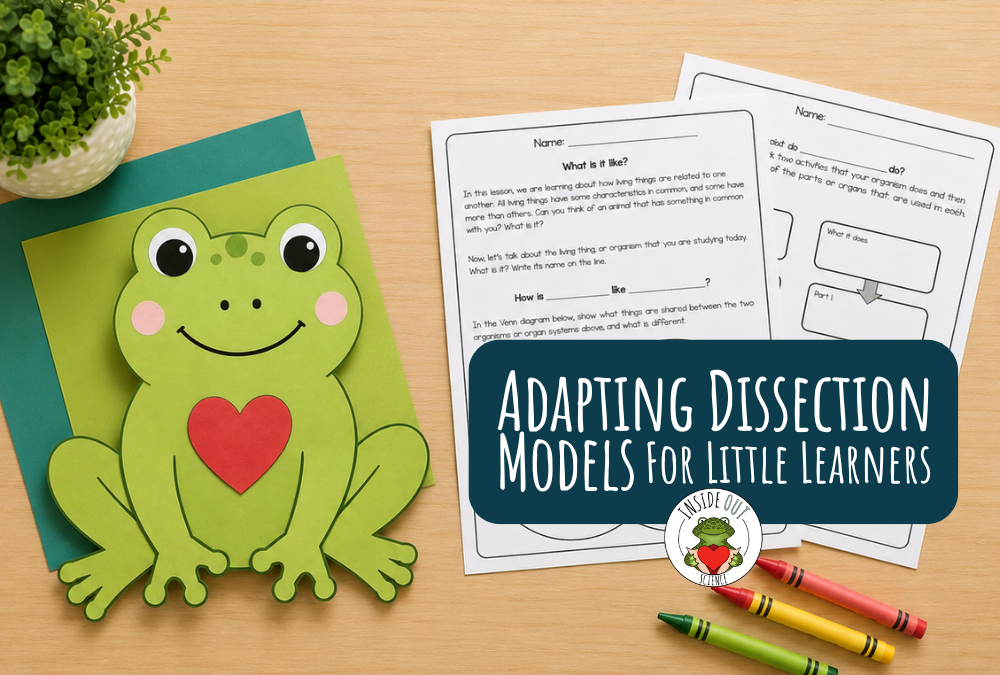
Inside Out Science’s 3-D Scienstructable™ paper models (formerly Getting Nerdy) might be designed for middle and high school students, but with a little creative scaffolding, they can become a powerful and engaging learning tool for younger scientists, too. Elementary students are naturally curious, hands-on learners, and they thrive when we make complex topics tangible, visual, and interactive. By layering supports – like simplified readings, age-appropriate graphic organizers, and guided model building or pre-made models – you can make even challenging life science topics accessible and exciting for your youngest learners.
Why Bring 3-D Models into Elementary Classrooms?
Elementary students often learn science through observation and storytelling, but physical models give them something even better: the chance to touch and create representations of living systems, turning abstract concepts into concrete, memorable experiences.
When your little learners use 3-D paper models, they are:
-
Encouraged to use fine motor skills and spatial reasoning.
-
Invited to work collaboratively, building teamwork.
-
Provided a bridge between “looking at pictures” and “understanding systems.”
Step 1: Start with a Simplified Story
Before diving into the model, hook your kiddos with a fun narrative about the organ or organism at hand.
- For example, if you’re using the worm model for a unit on worm composting, read a short story from the viewpoint of the worm doing its daily duty digging in the dirt.
- If you’re learning about cells, introduce the “cell as a city” analogy and invite your kids to relate the structures of the cell with the jobs that make a city work. The Capitol is the nucleus, the mitochondria is the power plant, etc.
Teacher Tip: Use read-alouds with big, colorful visuals, focusing on 3–4 key terms (not the entire vocabulary list).
Step 2: Scaffold with Graphic Organizers
Graphic organizers help students organize what they’re learning before they see the whole model.
Here’s a few ideas for elementary-friendly organizers:
-
Part-to-Function Matching Chart → Create a table where students draw a simple sketch of the part and write what it does in their own words. This can be done in a group brainstorm, or can be guided by the teacher as well.
-
Compare & Contrast Venn Diagram → Have students compare the model organism to something they already know (e.g., compare a frog’s body parts to a human’s).
-
Sequencing Flow Chart → Prompt students to think about a bodily process and the show the sequence or order of how a system works (e.g., “Food travels from here → here → here”).

Teacher Tip: Keep it visual—stick figures, arrows, and color-coding work wonders for younger brains. Limit the number and complexity of systems and organs that they need to learn as well so that information overlad doens’t keep them from getting the bigger picture.
Step 3: Break the Model into Mini-Lessons
Elementary students may not be ready to assemble an entire model in one sitting, or even at all. Instead, try some of these easy ways to introduce dissection to your bitties:
Part 1: Learn and build one section (e.g., the head or the digestive system). You can divvy this up throughout a unit or over the course of the year depending on your units of study. As you move on…
Part 2: Add the next section, reviewing what you’ve already built.
Part 3: Put it all together, then label as a class.
Teacher Tip: Keep it simple – younger kids just need the fundamentals (but don’t discourage their curiosity, either!) This chunking approach keeps the build from feeling overwhelming and reinforces learning at each stage.
Step 4: Use Guided Model Building
There are lots of ways to use IOS models and make them a valuable learning experience. For your younger learners, you can:
-
Pre-cut pieces (or have an adult cut them ahead of time for safety).
- Cut and laminate a class set of models and use velcro for the attachment points, This way, students can assemble and disassemble models class to class. Do it, and then never have to do it again.
-
Provide step-by-step instructions with pictures which, thanks to IOS, has already been done for you in the PowerPoint presentation included in each dissection model purchase.
-
Have class check-in points where students hold up their work to show progress so you can get a visual on their progress.
Teacher Tip: Consider pairing older students or parent volunteers with younger learners for a buddy-building experience.
Step 5: Make It a Multi-Sensory Experience
This applies to all students, so it shouldn’t surprise you that elementary students learn best when all their senses are engaged.
-
Use colored pencils to code systems (red for arteries, blue for veins) – again, color keys are provided for you in all of our models so that you can use the models for a comparative anatomy experience.
-
Add movement – have students “become” different parts and act out their functions. This is a great way to get the wiggles out and keep your kid’s minds focused and sharp.
-
Play sound effects (heartbeat, animal calls, digestion gurgles) to reinforce concepts.
Step 6: Reflect and Share
Once you’ve gotten through the process of building the models:
-
Have students use sentence starters like “My favorite part was…” or “I learned that…”
-
Display the models in the hallway or your classroom science corner.
-
Encourage a “museum walk” where students explain their models to visitors.
Sample Elementary Adaptation: Frog 3-D Model
- Start with a Story: Pick a book related to the organism you are studying. I just found this great book on Amazon called I Am Frog which follows the life of a tree frog and its importance to humans and the environment. Any children’s book that is engaging and helps kids to relate to the animal on a deeper level is perfect.
- Make connections: Use one of the organizers above to get kids thinking about how frog anatomy compares to other organisms or themselves. Have them draw a simple frog or download a black-line image that students can use to label 3 parts (ex: mouth, lungs, legs).
- Model: Break up the building of the model into sections that students can assist with – head/mouth section on Day 1, internal organs Day 2, finishing touches Day 3. You can also print and cut out a colored version, laminate it, and then cut again. Add velcro for the attachment points and have students assemble over and over again.
- Extension: Try out some of the things they’ve learned so they can put comparative anatomy to the test. Compare frog jumping to human jumping! Can students grab a jellybean with their tongues like a frog snatches flies out of the air?
- Reflect: Have students brainstorm ways that humans have made themselves more frog-like – fins for swimming, goggles to protect eyes underwater. Use the reflection sheet above to have students make final connections to the lesson.

Dissection models don’t need to be watered down to be meaningful for younger students. With careful scaffolding—storytelling, simplified readings, graphic organizers, and gradual model building – you can bring the wow factor of hands-on science to elementary classrooms in a way that’s developmentally appropriate, memorable, and fun.
