Differentiating Dissection Instruction

Differentiating Dissection Instruction

Dissection days can spark excitement and curiosity, inspire future scientists, and bring life science concepts into scalpel sharp focus. But for some students, these activities can also present lots of barriers. Whether those barriers are physical, emotional, sensory, or cognitive, as educators, it is our job to ensure that all students have access to the same rich learning opportunities by differentiating dissection instruction, regardless of their starting point.

Differentiating dissection instruction means planning with your students in mind – including flexibility for both the teacher and the student, providing multiple modes of engagement, and creating inclusive resources. Here are several practical ways to make your dissection lessons accessible to every learner.


1. Offer Humane, Hands-On Alternatives

Not every student is ready—or willing—to participate in animal dissection. Having an alternative that still meets learning goals keeps everyone included.

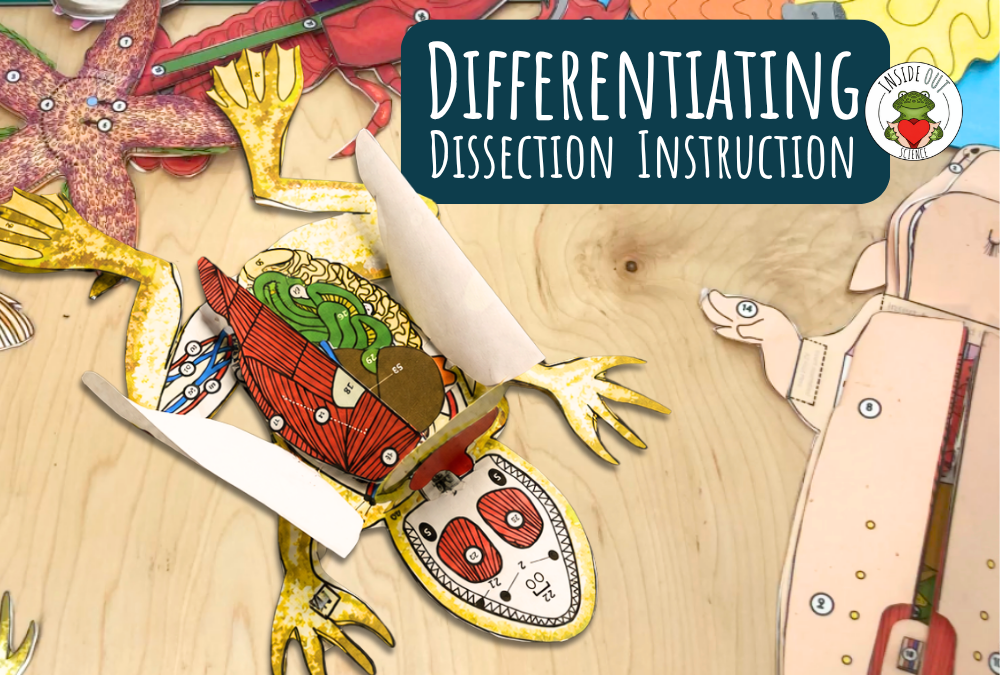
  • 3-D Paper Dissection Models: IOS models let students build, label, and explore accurate anatomical structures without using preserved specimens. They’re reusable, affordable, eco-friendly and practically mess-free.

  • Clay Organ Modeling: Another great option to show what you know, clay modeling encourages kinesthetic learners to build what they see without the stress of. true dissection.

  • Virtual Dissections: Technology has made it so easy to dissect virtually, and anatomy apps allow digital exploration without the sensory challenges. Check out options like Froguts or Victory XR’s VR and AR options. 


2. Scaffold the Language and Vocabulary

  • Can’t stress enough how important science vocabulary is to understanding dissection and the bigger picture concepts of life science. Pre-teaching roots, prefixes, and suffixes will allow students to make connections through the dissection, making grasping and retaining knowledge that much easier. (Cardio = heart, Hepatic = liver, Neuro = nerves)

  • Throw vocab at them in every way possible. Multiple methods of exposure ensures that you’re hitting all the learning modalities, from the use of labeled diagrams, visual word walls, and bilingual glossaries, you can give students what they need at every possible opportunity. 

  • Breaking things down into digestible chunks helps to prevent student overwhelm. Providing simplified definitions or visual mnemonics (think a drawn heart with the word heart inside) helps students further connect to the vocabulary. .


3. Adapt for Sensory Needs: Best Practices That Can Benefit Everyone

  • Use odor-reducing trays or fume hoods. Many students (and teachers for that matter) struggle with the fumes that come from dissected specimen. Formalin-free specimen can be a bit more expensive though, so maybe this is a great place to ask for grant money or create a DonorsChoose site. 
  • Offer glove and eyewear choices for comfort. All students should be wearing their PPE, but offering alternatives to meet their personal preference can ensure a level of comfort while doing something that may be out of their comfort zone.  

  • Allow students to step away when needed and re-engage at their own pace. When students feel more in control of their experience, they are more likely to continue to engage in the process rather than shut down because they feel forced. 


4. Modify the Task, Not the Goal

  • You want students to get the overall picture here. Odds are, they aren’t going to need to know every structure before they graduate high school, so reduce the number of structures some students need to identify. Pick a few main organs from each system and make sure they understand the main function. 

  • Lend some extra support by providing graphic organizers or partially completed diagrams, helping those students who are overwhelmed to feel more successful.

  • You can modify for your kids who need a challenge, too. Extend dissection tasks for advanced learners by including comparative anatomy. creating a case study, or have them research adaptations.


5. Use Collaborative Grouping

Make your dissections smoother and ensure participation by assigning group roles so everyone contributes. Here’s a few roles you can try:

  • Instructor: provides the instructions to other group members for making incisions or following other tasks.
  • Lead Dissector: makes incisions and pins specimen.
  • Recorder: writes down information gathered during dissection, creating diagrams and noting any findings.

  • Photographer: captures and labels images.

  • Researcher: provides real-time background info.


6. Build in Reflection and Choice in the Assessments

Just like the lab itself, assessments should allow flexibility while targeting the same core objectives. Here are ways to make your grading more inclusive:

  • Choice Boards: Offer 3–4 options for demonstrating understanding – a written lab report, a labeled model, an illustrated poster, or a short video explanation to name a few – and allow students to choose what fits their strengths.

  • Tiered Diagrams: Provide diagrams with varying levels of labeling. Some may have blanks for every structure, while others may have a word bank or partial labels.

  • Oral Explanations: For students who struggle with writing, let them verbally walk you through the dissection or model, explaining structures and functions.

  • Model Reconstruction: Have  few laminated models that use velcro as the assembly points and have students show their mastery by correctly reassembling a paper dissection model and labeling the parts.

  • Case Study Questions: Present short scenarios (e.g., “This organ is damaged; how might that affect the organism?”) that let students apply their knowledge instead of only recalling terms.

  • Notebook or Portfolio Assessments: Throughout the unit, have students collect notes, photos, sketches, and reflections, allowing them to build a complete  picture of their learning over time. 

Differentiating dissection instruction isn’t about lowering expectations—it’s about removing barriers to accessibility for every student. By combining humane, hands-on alternatives like Inside Out Science’s 3-D paper models with thoughtful scaffolding, sensory supports, flexible grouping, and varied assessments, you create an environment where every student can be curious, engaged, and successful.

When all students have access, dissection becomes less about who can “handle it” and more about shared discovery—a true hallmark of great science education.

The best lessons come from the inside out... www.insideoutsci.com
What’s the story behind Morris the Frog?

What’s the story behind Morris the Frog?

Every logo tells a story, and Inside Out’s happens to be a story about a little green frog named Morris with a heroic mission. Just like Clark Kent becoming Superman, you’ll see Morris tugging open his dissected chest to reveal a giant, bright red heart. This frog is more than just a mascot; he represents the power of humane dissection alternatives and the love behind Inside Out’s mission of saving the planet, one specimen at a time. His wide open heart is a symbol of compassion, showing that science can be both educational and kind.

Why Morris?

The frog’s name is Morris – my dad’s middle name – and was chosen to honor his memory. Dad had a lifelong fascination with animals. He loved learning about how they worked and loved sharing stories with me about anything he learned – how hummingbirds are the only birds to fly backwards or that turtles breathe through their butts during winter (his favorite one to tell). Dad was always my biggest cheerleader and was constantly blown away by how I designed the models. Naming the frog Morris is my way of weaving dad’s memory into every piece of my work. It’s a constant reminder that his curiosity and encouragement will always fuel the heart of Inside Out Science. Long before dad passed, he told me that he wanted me to make a horseshoe crab model in memory of his childhood, growing up on the Outer Banks. That request has stayed with me and remains on my list of models to create. It’s more than a project to complete – it’s a promise to my favorite person.

From Getting Nerdy to Inside Out Science

Inside Out Science is also the next chapter in my journey as a science educator. Many of you may know me from my adventures as co-creator of Getting Nerdy with Mel and Gerdy, where I poured my energy into creating engaging, hands-on classroom resources. Inside Out Science builds on that same passion but with a new perspective – focusing on 3-D paper dissection models and humane alternatives that place compassion and curiosity at the center of the mission. It’s my way of honoring where I’ve been while continuing to grow, innovate, and share the joy of science in fresh and meaningful ways.

Inside Out's Morris... the frog behind the science. www.insideoutsci.com

More than a Mascot: Morris’s Big-Hearted Mission

So when you see Morris the Frog proudly opening his chest to reveal his heart, know that he’s not just a quirky logo. He’s a hero, a champion of animals, a teacher, and a tribute – showing the world that science can be hands-on, meaningful, and humane, while also carrying the legacy of a person who believed in the beauty of learning how life works.

The best lessons come from the inside out... www.insideoutsci.com
Adapting Dissection models for Little Learners

Adapting Dissection models for Little Learners

Inside Out Science’s 3-D paper models might be designed for middle and high school students, but with a little creative scaffolding, they can become a powerful and engaging learning tool for younger scientists, too. Elementary students are naturally curious, hands-on learners, and they thrive when we make complex topics tangible, visual, and interactive. By layering supports – like simplified readings, age-appropriate graphic organizers, and guided model building or pre-made models – you can make even challenging life science topics accessible and exciting for your youngest learners.

Why Bring 3-D Models into Elementary Classrooms?

Elementary students often learn science through observation and storytelling, but physical models give them something even better: the chance to touch and create representations of living systems, turning abstract concepts into concrete, memorable experiences.

When your little learners use 3-D paper models, they are:

  • Encouraged to use fine motor skills and spatial reasoning.

  • Invited to work collaboratively, building teamwork.

  • Provided a bridge between “looking at pictures” and “understanding systems.”

Step 1: Start with a Simplified Story

Before diving into the model, hook your kiddos with a fun narrative about the organ or organism at hand.

  • For example, if you’re using the worm model for a unit on worm composting, read a short story from the viewpoint of the worm doing its daily duty digging in the dirt.
  • If you’re learning about cells, introduce the “cell as a city” analogy and invite your kids to relate the structures of the cell with the jobs that make a city work. The Capitol is the nucleus, the mitochondria is the power plant, etc.

Teacher Tip: Use read-alouds with big, colorful visuals, focusing on 3–4 key terms (not the entire vocabulary list). 


Step 2: Scaffold with Graphic Organizers

Graphic organizers help students organize what they’re learning before they see the whole model.

Here’s a few ideas for elementary-friendly organizers:

  • Part-to-Function Matching Chart → Create a table where students draw a simple sketch of the part and write what it does in their own words. This can be done in a group brainstorm, or can be guided by the teacher as well. 

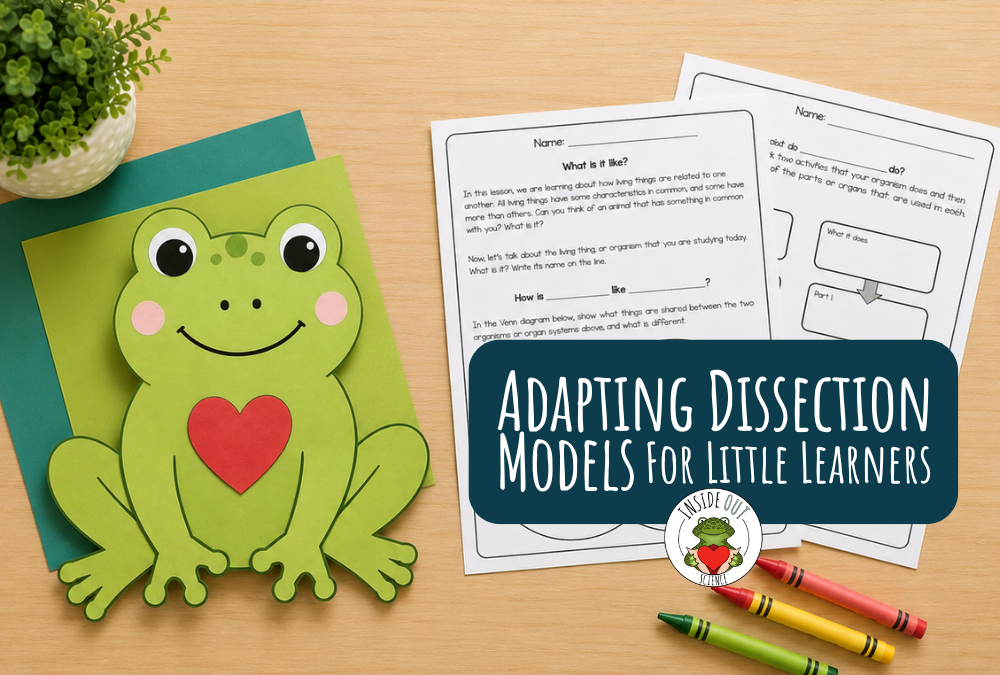
  • Compare & Contrast Venn Diagram → Have students compare the model organism to something they already know (e.g., compare a frog’s body parts to a human’s).

  • Sequencing Flow Chart → Prompt students to think about a bodily process and the show the sequence or order of how a system works (e.g., “Food travels from here → here → here”).

Bring dissection models to your little kiddos with these simple modifications. www.insideoutsci.com

Teacher Tip: Keep it visual—stick figures, arrows, and color-coding work wonders for younger brains. Limit the number and complexity of systems and organs that they need to learn as well so that information overlad doens’t keep them from getting the bigger picture.  

Step 3: Break the Model into Mini-Lessons

Elementary students may not be ready to assemble an entire model in one sitting, or even at all. Instead, try some of these easy ways to introduce dissection to your bitties:

  1. Part 1: Learn and build one section (e.g., the head or the digestive system). You can divvy this up throughout a unit or over the course of the year depending on your units of study. As you move on… 

  2. Part 2: Add the next section, reviewing what you’ve already built.

  3. Part 3: Put it all together, then label as a class.

Teacher Tip: Keep it simple – younger kids just need the fundamentals (but don’t discourage their curiosity, either!) This chunking approach keeps the build from feeling overwhelming and reinforces learning at each stage. 


Step 4: Use Guided Model Building

There are lots of ways to use IOS models and make them a valuable learning experience. For your younger learners, you can:

  • Pre-cut pieces (or have an adult cut them ahead of time for safety).

  • Cut and laminate a class set of models and use velcro for the attachment points, This way, students can assemble and disassemble models class to class. Do it, and then never have to do it again. 
  • Provide step-by-step instructions with pictures which, thanks to IOS, has already been done for you in the PowerPoint presentation included in each dissection model purchase. 

  • Have class check-in points where students hold up their work to show progress so you can get a visual on their progress.

Teacher Tip: Consider pairing older students or parent volunteers with younger learners for a buddy-building experience.


Step 5: Make It a Multi-Sensory Experience

This applies to all students, so it shouldn’t surprise you that elementary students learn best when all their senses are engaged.

  • Use colored pencils to code systems (red for arteries, blue for veins) – again, color keys are provided for you in all of our models so that you can use the models for a comparative anatomy experience.

  • Add movement – have students “become” different parts and act out their functions. This is a great way to get the wiggles out and keep your kid’s minds focused and sharp.

  • Play sound effects (heartbeat, animal calls, digestion gurgles) to reinforce concepts.


Step 6: Reflect and Share

Once you’ve gotten through the process of building the models:

  • Have students use sentence starters like “My favorite part was…” or “I learned that…”

  • Display the models in the hallway or your classroom science corner.

  • Encourage a “museum walk” where students explain their models to visitors. 

Sample Elementary Adaptation: Frog 3-D Model

  1. Start with a Story: Pick a book related to the organism you are studying. I just found this great book on Amazon called I Am Frog which follows the life of a tree frog and its importance to humans and the environment. Any children’s book that is engaging and helps kids to relate to the animal on a deeper level is perfect. 

  2. Make connections: Use one of the organizers above to get kids thinking about how frog anatomy compares to other organisms or themselves.  Have them draw a simple frog or download a black-line image that students can use to label 3 parts (ex: mouth, lungs, legs).

  3. Model: Break up the building of the model into sections that students can assist with – head/mouth section on Day 1, internal organs Day 2, finishing touches Day 3. You can also print and cut out a colored version, laminate it, and then cut again. Add velcro for the attachment points and have students assemble over and over again. 

  4. Extension: Try out some of the things they’ve learned so they can put comparative anatomy to the test. Compare frog jumping to human jumping! Can students grab a jellybean with their tongues like a frog snatches flies out of the air?

  5. Reflect: Have students brainstorm ways that humans have made themselves more frog-like – fins for swimming, goggles to protect eyes underwater. Use the reflection sheet above to have students make final connections to the lesson.   


Getting Nerdy's dissection models are now Inside Out Science! 3-D paper dissection models that foster a deep connection with anatomy while providing humane alternatives.<br />
www.insideoutsci.com

Dissection models don’t need to be watered down to be meaningful for younger students. With careful scaffolding—storytelling, simplified readings, graphic organizers, and gradual model building – you can bring the wow factor of hands-on science to elementary classrooms in a way that’s developmentally appropriate, memorable, and fun.


The best lessons come from the inside out... www.insideoutsci.com
The Value of Dissection & Why Humane Options are Just as Effective

The Value of Dissection & Why Humane Options are Just as Effective

For so many students, the word dissection sparks a mix of curiosity AND apprehension. Whether it’s frogs, fish, or organ specimens, the practice has been a staple of science classrooms since the dawn of the scalpel – but is dissection really necessary when it comes to elementary and middle school classrooms? In this day and age with advent of the digital era and the ever present ethical implications, do we really need to do dissection at all? Is there value in dissection, how does it translate into skills beyond the lab, and do humane alternatives—like Inside Out Science’s 3D paper dissection models—deliver the same learning experience? All your burning questions… answered here.


Why Does Dissection Matter?

There is value in dissection. Dissection is more than a hands-on way to explore anatomy – it’s an opportunity for your kiddos to develop critical thinking, observational precision, and applied problem-solving skills. They don’t just learn what a heart looks like; they learn how its structures relate to its functions, how organ systems interconnect with one another, and how living organisms are organized at both macro and micro levels (think “speck of dust to the cosmos…”). 

Dissection provides experiential learning that promotes:

  • Spatial understanding: Students gain a three-dimensional awareness of body structures.

  • Scientific inquiry skills: They ask questions, form hypotheses, and analyze evidence.

  • Attention to detail: Fine dissection work builds focus and patience.


Will This Translate to Real Life?

The skills developed during dissection extend far beyond biology class. Many career paths value the precision, hand-eye coordination, and analytical thinking dissection fosters, including:

  • Medicine & Nursing: Dissection of less complex specimen helps students to understand human anatomy and physiology at a deeper level.

  • Veterinary Medicine: These same skills can be useful when applying their anatomical knowledge to animal health and care.

  • Forensics & Pathology: Understanding anatomy is important in investigating causes of injury or disease.

  • Biological Research: Studying form and function in various organisms leads the way for development of medical technology.

  • Wildlife & Conservation Work: Understanding anatomy for species care and rehabilitation.

Even students who never enter a science field benefit from the problem-solving mindset and meticulousness dissection encourages. 


Is Dissection Necessary in Middle School?

Dissection can be an exciting rite of passage in science class, but is it always necessary at the middle school level? There is value in dissection, but there is also value in humane alternatives. At this stage, students are often still building foundational knowledge of anatomy and biology and they can benefit just as much – sometimes more – from visuals, models, and guided activities that introduce them to systems and structures without the complexity (and sometimes stress) of dissecting a real specimen.

Exposure to humane dissection alternatives, such as Inside Out Science’s 3D paper dissection models, can provide the same sense of hands-on discovery in a way that’s age-appropriate, reusable, and approachable. These models allow middle school students to practice labeling, identifying structures, and understanding relationships between organs without the pressure of performing a technical dissection.

By the time students reach high school and beyond, dissection (whether traditional or via realistic alternatives) becomes more relevant, especially for those interested in medicine, nursing, veterinary studies, or biology-focused careers. Here, the practice can deepen anatomical understanding and refine technical skills like precision and hand-eye coordination – critical for future professional pathways.

In short: middle school is the perfect place for introduction and exploration, while high school is the time for application and mastery. With modern humane tools, educators can scaffold this progression in a way that’s both ethical and effective.


Humane Dissection Options: A Modern Solution

Many schools now use humane dissection alternatives  – including 3D paper models, interactive simulations, and realistic anatomical replicas – that provide all the benefits of traditional dissection without using preserved specimens.

At Inside Out Science, our authentic, eco-friendly 3D paper dissection models are designed to give students a tactile, accurate, and memorable anatomy experience. They allow learners to:

  • Explore organs and systems layer-by-layer.

  • Make connections between structure and function.

  • Revisit and review as often as needed – something a one-time dissection doesn’t allow.

In addition to the educational benefits, these alternatives also:

  • Address ethical concerns: No animals are harmed or harvested.

  • Reduce costs: Models are reusable, relatively inexpensive with respect to recurring costs, and require no special storage.

  • Increase accessibility: Perfect for students unable to participate in traditional dissections due to allergies, religious beliefs, or personal choice.

Getting Nerdy Dissection is now Inside Out Science! Humane paper dissection lessons for your eco-friendly explorers!

The Best of Both Worlds

The value of dissection lies in helping students connect scientific concepts to real-world biological structures. Whether through preserved specimens or humane alternatives like Inside Out Science’s 3D paper models, the goal remains the same: to inspire curiosity, develop precision, and foster deep biological understanding. By embracing modern, ethical tools, educators can make anatomy learning more accessible, inclusive, and engaging for every student – without sacrificing rigor or authenticity.

The best lessons come from the inside out... www.insideoutsci.com
5 Ways to Manage the Mayhem: Dissection Day Best Practices

5 Ways to Manage the Mayhem: Dissection Day Best Practices

Ready to bring your anatomy labs to life without turning your classroom into chaos central? Dissections can be a total win for teaching comparative anatomy to middle and high schoolers. They are always blown away when they realize how closely animals’ parts mirror ours… wait, frogs have lungs, too?!? If the idea of dissection makes you nervous, this year’s the year to give it a shot – either with real specimens or virtual options. Here’s 5 dissection day best practices sure to make your dissection days smooth, smart, and yes—stress-free:


Prep Like a Pro1.png

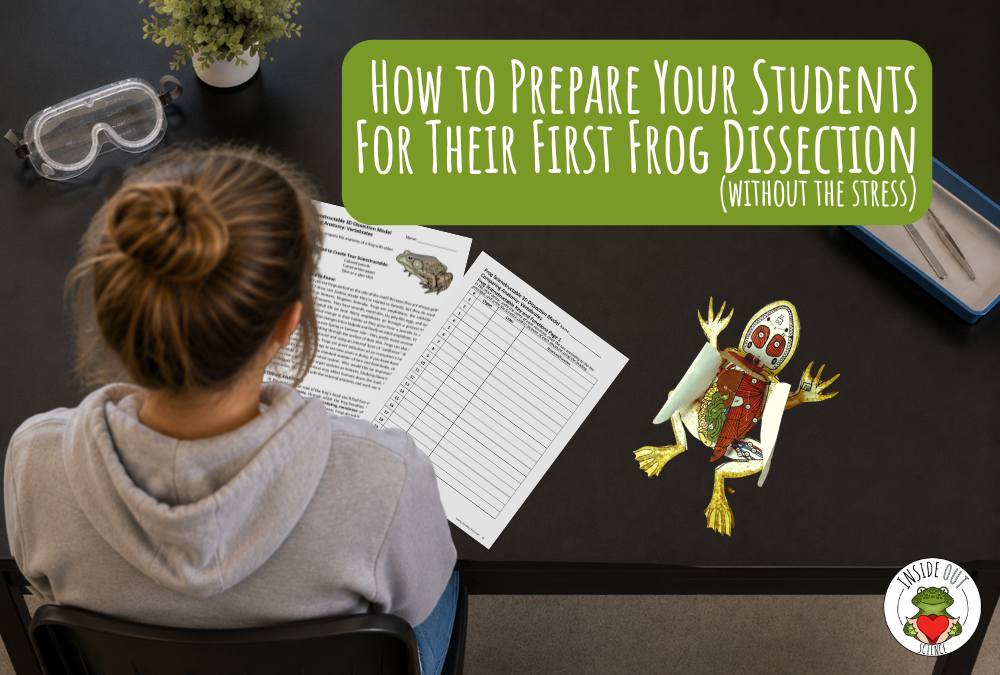
Start a few days early with an IOS 3-D paper model to help students get comfy with the anatomy and dissection process before the real deal. The student-friendly reading helps your kiddos learn the structure and function of each organ. Then, break out the colored pencils, scissors and glue sticks. IOS models use a consistent color key across systems to help students see how organs relate to each other, so comparative anatomy has never been so easy. Have students get to work coloring and cutting out everything they’ll see in the organism in question. Assemble as a class and throw in some follow-up questions. The model doubles as both a learning tool and a practice dissection—less stress for everyone before and during dissection day, especially first-timers. Personally, I consider this a dissection ay best practice and never let students dissect until their models were complete. 

5 tips to manage dissection chaos without losing your mind! www.insideoutsci.com

2.pngSet Expectations

The day before dissection day, spend some time reviewing by showing specimen photos or videos, demonstrating the proper use of tools, and going over lab safety rules. Share a classroom horror story (like the kid who thought pretending to eat part of a sheep eye specimen was hilarious) – and let it highlight exactly why lab behavior matters.

At the beginning of the year and even before each dissection, consider having students sign a safety/behavior contract, and remind them that dissection is a privilege, not a right. Anyone who acts out can be moved to another assignment – and nobody wants that. Here’s a perfect lab safety contract (printed two per page) for dissection days that’s all yours to download:

Teacher Tip: Frame safety rules with a little humor. Kids will remember—and respect—them more.

3.pngQuiz, Then Team Up

Another dissection day best practice is to wrap up your prep day with a quick quiz covering dissection and lab safety, and toss in some questions about the organism’s classification. Use your quiz results to create balanced groups of leaders and kiddos that need a little support – depending on your class size, stick to 6-7 groups total or the chaos will grow exponentially. 

4.png Dissect in Phases (for Your Sanity)

Just. Don’t. Don’t try to cram the entire dissection into one block (unless you somehow have a two-hour block of time). Split your dissection into two days – avoid scalpels if possible  just scissors, pins, probes, and forceps.

  • Day One: Focus on the external anatomy. One life-saving technique is to have a checklist to help guide students in identifying and keeping track of external features, as well as having their models or notes handy. Once they’re ready, come by and verbally quiz them, asking each student to identify something. If they are struggling, let them “phone a friend” and ask a group mate for assistance. Initial their checklist and let them move on with their exploration. Wrap up with cleanup and store specimens in plastic bags.

  • Day Two: Stick with the same groups. Start with a quick safety reminder, then move into internal anatomy. Use the same flow—explore, quiz, cleanup, store.

Why it Works: Students learn more deeply, and you keep control of the pace. Breaking it up gives students more time to digest (pun intended!) what they’re learning, and gives you less mayhem to juggle at once, and the verbal quizzes take the pressure off of the kids to know everything right then and there, while still allowing you to make informal assessments of their learning experience.

5.pngTest in Style—On Your Terms

The best advice for lab practical days is to keep the specimen that the kids dissected (if they didn’t destroy them). Create stations around the room, keep specimen moist with damp paper towels, and clearly pin internal and external parts for identification. Add some 3-D paper models into your station rotations as a way to test your students on their assignment as well. Some helpful differentiation ideas and best practices:

  • Offer a multiple-choice or word-bank format for students who need support.

  • Challenge advanced learners with short-answer questions.

  • Rotate groups through stations every couple of minutes- keeps the pace snappy and the focus sharp.


What If Students Can’t (or Don’t Want to) Dissect?

In my first year of teaching, I had a student who refused to dissect, and I think it’s important to respect the fact that not every student is comfortable with dissection… that’s okay. Be prepared with alternative options that provide a similar learning experience like:

This ensures all students learn the anatomy—even if they’re not hands-on with a specimen.


Classroom Management Hacks That Save Your Sanity

Dissections are messy, no way around it. But you can minimize the chaos with a few simple systems:

  • Have a set method for completing dissection. Using a dissection exploration template like the one below will surely keep your dissections on track.
  • Pre-label cleanup stations and assign jobs (wiper, sprayer, bag-sealer).

  • Have a dedicated “specimen trash” bin.

  • Stock each station with extra gloves and paper towels so you’re not running around like crazy.

  • Keep a stock of hair-ties for your students with long hair. 
  • Laminate checklists so that they can be reused and wiped between classes – saves on paper!

Your future self will thank you…

Go deep with dissection with this comprehensive lab report template! A great tool for dissection day best practices...<br />
www.insideoutsci.com


Make It Memorable with Reflection

A great way to wrap up your dissection is to ask students to pause and reflect. A quick 5–10 minute activity will help to make the experience stick:

  • Have them sketch one organ and label it.

  • Ask: “What’s one similarity you noticed between this specimen and humans?”

  • Or try: “What surprised you most about this dissection?”

These little reflections turn a hands-on activity into a true learning moment.

Things will get a little messy, and that’s totally normal! The goal isn’t a picture-perfect dissection, it’s bringing those dissection day best practices to your classroom and giving your students a chance to explore, ask questions, and see the incredible connections between themselves and the organisms they are exploring. Lean into the chaos—it’s all part of the magic. Your students will remember the experience, and you’ll walk away knowing you turned what could’ve been mayhem into a memorable learning adventure.

The best lessons come from the inside out... www.insideoutsci.com